
China's GDP growth slowed in the second quarter this year to 7.5 per cent, official data showed on Monday, as the Chinese leadership faced fresh challenges to stimulate and revamp the world's second-biggest economy.

If TVK MLAs and ministers are perceived as clean, or demonstrably cleaner than their predecessors, the credibility dividend will be enormous. The voter will feel rewarded, points out Ramesh Menon.
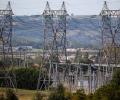
The growth of these core sectors -- coal, crude oil, natural gas, refinery products, fertiliser, steel, cement and electricity -- was 4.6 per cent in April 2023.
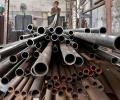
Growth of eight key infrastructure sectors slowed down to 8.2 per cent in June 2023 compared to the year-ago month due to a decline in the production of crude oil, according to the official data released on Monday.

Less than half of all graduates were employed, with 48.8 per cent reporting some form of work.

'We kept this Budget on a larger plank, rather than on one incident, however serious.'

China's post COVID-19 pandemic economic rebound showed signs of slowdown as the economy grew at 7.9 per cent in the second quarter compared to a record 18.3 per cent in Q1, while the GDP expanded 12.7 per cent year on year in the first half amid the continued global spread of the coronavirus and unbalanced domestic recovery. In the second quarter, the GDP of the second largest economy in the world grew 7.9 per cent year on year, the data released by the National Bureau of Statistics, (NBS) on Thursday showed. On a quarterly basis, the economy expanded 1.3 per cent in Q2.

'Despite a challenging FMCG environment, ITC Foods has grown at or above the industry rate.'

The IIP data showed a significant slowdown in the manufacturing sector, which grew at 4.2 per cent in July 2019 as compared to 7 per cent a year ago.

The six core infrastructure industries -- crude oil, petroleum refinery products, coal, electricity, cement and finished carbon steel --had registered a growth rate of 5.1 per cent in November 2007.
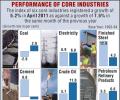
The slowdown comes a month after the six core infrastructure industries grew by 7.4 per cent in March.
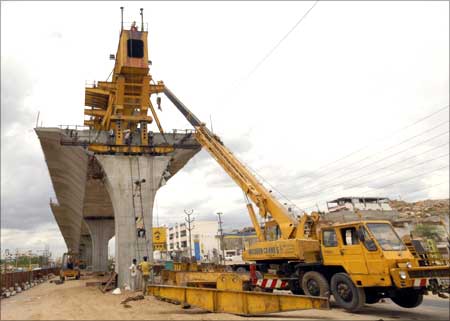
The growth rate was much higher a year ago at 8.7%.

There are hopes of a turnaround in overall corporate earnings after six quarters of single digit growth.

Prosus, the Amsterdam-based technology investor with net assets valued at over $200 billion spanning payments to e-commerce, has identified India as one of its most critical growth markets, and is increasing its strategic investments here.

'At the first sign of real trouble, that money will move. There will be a run.'

West Asia conflict triggers sharp sell-off in Indian markets, with realty, banking and auto stocks leading losses amid energy shock fears.

The cost of the war is being counted not in the corridors of power in Washington or Tehran, but in Firozabad's darkened furnace rooms, Howrah's idle casting sheds, and a barbershop in Kochi where the wait is suddenly, inexplicably, an hour long, notes Prem Panicker in his must read blog on the Iran War.

Benchmark stock indices Sensex and Nifty rebounded on Thursday after two days of decline, mirroring a rally in global markets as a US court blocked President Donald Trump's reciprocal tariffs. The 30-share BSE Sensex climbed 320.70 points or 0.39 per cent to settle at 81,633.02.

'The West Asia or the Gulf crisis has shown that what we develop as national infrastructure when things are not as bad as they could be, we forget to plan for adversities.'

The eight key infrastructure sectors' growth rose by 6.3 per cent in May on healthy expansion in the production of coal, natural gas, and electricity, though the growth rate is lower than in April, according to official data released on Friday. The production of the eight sectors grew 6.7 per cent in April. The growth of these core sectors -- coal, crude oil, natural gas, refinery products, fertiliser, steel, cement and electricity -- was 5.2 per cent in May 2023.

The size of the GDP in the second quarter of 2018-19 is estimated at Rs 33.98 lakh crore, as against Rs 31.72 lakh crore a year ago

Coal, natural gas and fertiliser showed decline in output raising concerns for the industry and government.

Expressing concerns over slow industrial production growth, industry today asked the Reserve Bank to cut rates in its policy review next month to boost investments and bring the growth back on track.
Pulled down by the sluggish performance of petroleum and electricity sector, growth of India's six core industries slowed down to 3.6 per cent in the first month of the current fiscal as against 5.9 per cent a year ago. The six core infrastructure industries - crude oil, petroleum refinery products, coal, electricity, cement and finished carbon steel - had registered a 9.6 per cent growth in the preceding month of March
Infrastructure growth declined marginally to 4.7 per cent during December 2005 from 4.8 per cent a year ago, largely on account of a sharp decline in crude oil output and poor performance in power sector.

Driven by GST reforms, robust festive demand, and softening raw material prices, the FMCG industry expects volume-based growth, supported by a mid-single digit revenue rise and improved operating margins in the December quarter.

Fertiliser production dropped sharply by 11.5 per cent, crude oil by 5 per cent and natural gas by 0.9 per cent in October over the year-ago month

'The outlook for the next Samvat is more constructive, as many of the earlier drags are gradually becoming supports.'

The India-US trade deal has offered a much-needed breather for the Indian information technology (IT) industry, which has been grappling with global macroeconomic uncertainty and subdued client spending over the past few years.

The information technology (IT) services industry may be headed for another year of sluggish growth. Based on the results of the top five IT services companies for the first quarter of 2025-26 (Q1FY26), analysts say the possibility of hitting high single-digit revenue growth in FY26 looks unlikely.

Trends like bundled offers and 4G-LTE feature phones could become mainstream in 2018

A neutral monetary policy stance, heavy government borrowing, and issuers adjusting to a higher-for-longer yield environment have set the stage for a largely stable corporate bond market in 2026.

India should resist knee-jerk responses to tariff volatility in the US and instead use the current geopolitical churn to build manufacturing scale at home, former G20 Sherpa and former chief executive officer of NITI Aayog Amitabh Kant said on Wednesday.

While India's GDP growth slowed to five-year low of 5.8% in Q4, China grew at 6.4%.

'This will be our first large-size bank partner, and hence, the partnership will be a game-changer for us.'
The growth in production of eight key infrastructure sectors entered a negative zone after three-and-a-half years, contracting 1.8 per cent in August 2024 due to decline in output of coal, crude oil, natural gas, refinery products, cement and electricity, according to official data released on Monday. The growth rate was 6.1 per cent in July. The growth of core sectors -- coal, crude oil, natural gas, refinery products, fertiliser, steel, cement and electricity -- was 13.4 per cent in August 2023.

Hyundai aims to raise exports to 30% of output by FY30 as domestic sales slow; six EVs among 26 product launches planned as part of long-term growth strategy.

Electricity generation has outperformed the industrial production index for five months in a row this financial year, even as the broader economy is struggling to grow.

The previous low was recorded at 3.8 per cent in May this year.

Sanjay Malhotra takes charge as the 26th RBI governor at a time when headline retail inflation has shot up to 6.2%.
